We pride ourselves on making a genuinely impactful (and of course beautiful, durable) product. That’s what our slogan, “Make, Play, Live”, means. Our entire business from production to profit is geared around helping as many people as possible, and we think we’ve done a pretty good job so far! Alive and Kicking has created over 1000 fairly paid, ethical conditions jobs for our employees, donated 170,000 footballs to communities around the world, and much more, but we can always strive to do better. Today, we’re going to talk a little bit about something you may not know much about: our environmental sustainability.
Our entire impact framework is built with the UN’s Sustainable Development Goals in mind. This helps us to clearly align ourselves with the global strategies deemed most efficient and necessary, as well as ensuring our progress is transparent and easy to work alongside (since we love to collaborate with other organisations to maximise our impact). But what it also makes clear is that social and environmental sustainability go hand-in-hand.
Although our first priority has always been social impact, you can already see how the two relate in the production of our footballs. Very nearly all of our materials are sourced locally to where they are made, with only our ball bladders imported from another country. Our leather is offcuts sourced from local tanneries, meaning it is high-quality while remaining relatively cheap, so that as much money as possible can be funnelled to where it can really make a difference. Conveniently, these factors also mitigate the majority of the carbon emitted by producing a regular, mainstream football! While there is an ongoing debate over the ethics and sustainability of leather when weighing up animal rights, vegan (generally plastic) alternatives, gases produced by cows and so forth, our leather is offcuts and therefore at least no extra issues are generated. On top of this, the usual carbon footprint of transporting materials from all over the world, or even shipping the ball from country to country for different stages of the making process (watch our balls being made here for some idea of just how many steps this can take) is almost completely mitigated. In other words, our efforts to maximise our social impact through the money and employment opportunities we put into the local economy also mean that we are making a more environmentally friendly ball.
As our collaborator Jean-Baptiste, CEO and founder of Vista, put it – have a look at our recent chat with him here for some more information on the carbon footprint of the average football – nobody really thinks about where a football comes from. Nobody thinks about where they go either; and yet 20 million footballs go to landfill every year in Africa alone. There are budding initiatives around recycling balls and indeed just about every other football accessory from boots to pitches. However, for now we still have few options with regards to what to do with our footballs at the end of their lives. With Alive and Kicking balls, of course, this is less problematic than dealing with your average synthetic ball: ours is biodegradable. On top of this, it lasts several times longer than a mainstream football due to the quality of hand-stitching and materials used, so the frequency of waste is reduced at the source. But we shouldn’t be satisfied yet, and of the famous “Rs” of sustainability (there’s anywhere from 3 to 14, depending who you ask) there’s one we’ve been making big progress on, and that’s “repair”.
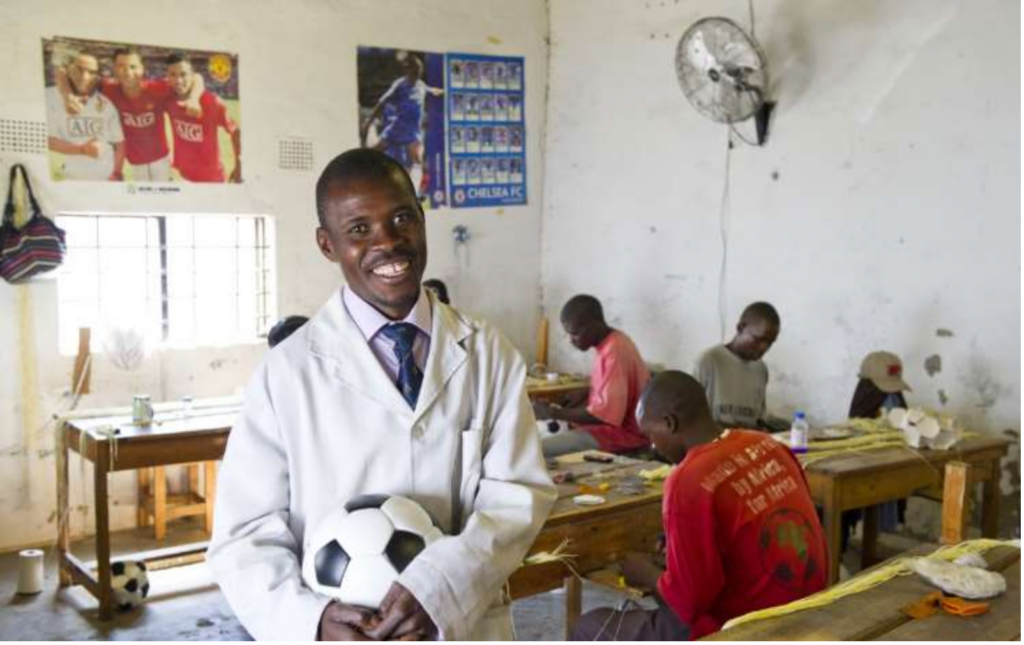
This brings us to our team in Zambia – headed by Jane Thiong’o – and something they’ve been doing for a long time. Anyone local to our Zambian centre can bring in any football for a repair if it gets a puncture or a seam comes undone, and our skilled hand-stitchers will sort it out. This is, of course, excellent for our environmental sustainability, feeding into what we hope will be an increasingly circular economy within our company. It extends the life of the ball and reduces the number of balls going to landfill. In some cases this even includes brand new balls, which are sometimes delivered to local retailers from overseas already damaged; working towards greater sustainability together is far more important than ‘competition’!
However, perhaps surprisingly, offering ball repair also helps us to maximise our social impact. By diversifying our services – while sticking to what we’re good at – as well as welcoming balls from any manufacturer, we expand our customer base and our profit, 100% of which as always goes into helping communities around the world. Secondly, the smaller, easier task of repairing a ball, as opposed to hand-stitching one from scratch, is ideal for employees who may need to reduce their workload for reasons including completing or pursuing further education, and family care responsibilities. This helps us to uphold our commitment to providing steady, fairly paid work for those who join our team even as their circumstances may change. Once again, without even trying we can see how social and environmental sustainability feed into one another.
Any progress towards ‘sustainability’ must be made without sacrificing the quality and durability of our products, or the social impact of our manufacturing centres and wider charity initiatives. This is an ongoing process. We’ve already started doing our best to ship orders from our production centres to points of distribution in bulk and by sea, and of course our ball has an unusually small carbon footprint already. We’re also thinking about using more recycled packaging and perhaps some day – as sustainable material engineering improves all the time – for the balls themselves. Having seen the success of the ball repair programme in Zambia, we’re now thinking of how we might be able to roll out something similar in other countries where our customers – but unfortunately not our trained stitchers – are based. Let us know if you have any interest in helping, suggestions, or think that there’s something you think we could be doing better.