World AIDS Day – commemorated on the 1st December since 1988 – is an international day dedicated to raising awareness of the AIDS pandemic caused by the spread of HIV infection. Last World AIDS Day, exactly two months ago, Sheba Nyaronga – CEO of Alive and Kicking Kenya – and her team organised, helped supply, and delivered a large HIV testing event. She made some time to tell us a little about it, and why it’s important to keep pushing for education and awareness around HIV.
In 2021, 94% of women in Kenya could tell you their status as opposed to 88% of men – and worldwide, the percentage of men who know their HIV status may be even lower. Thinking about why this gender imbalance may exist, Sheba said it might partly be “because […] the natural cycle of most women requires them to seek health care at some point.” In Kenya specifically, she added that “when a woman is pregnant they are required to take the [HIV] test to ensure the child is protected”. However, with their comparative lack of access to healthcare information – and as Sheba pointed out, “infection rate among youth is higher”, indicating that there is an awareness problem – it is vital that men and especially young men are also given the resources and information to properly protect themselves. This is not, of course, just a once-a-year priority! Still, public campaigns like ‘World AIDS Day’ and mass testing events help elevate the profile of the cause and spread word of its importance. It also helps if they disperse hundreds of bright red footballs reminding everyone to ‘GET TESTED’ out all over Nairobi!
Sheba believes that “the core of Alive and Kicking is creation of employment”. She’s not wrong; it’s the first part of our slogan-slash-strategy ‘Make, Play, Live’. It’s the sum of all three that makes our impact ripple out as far as it does, and makes us a charity special. “If you look at the history of Alive and Kicking even back to inception we had roadshows on health education. … Now that we are stabilising [after the COVID-19 pandemic and its continuing fallout], we want to do more with health education and encouraging help and health seeking behaviour”. This is why we work with local football coaches in Kenya, training them to deliver health education sessions through football. Knowing how hard social attitudes are to shed, we’ve always been proud to share that participants in these sessions state that they would be more likely to engage in friendly contact – say, a game of football – with someone who they knew to be HIV-positive – we see an average 42% improvement in attitudes associated with HIV . Still, the battle is far from over.
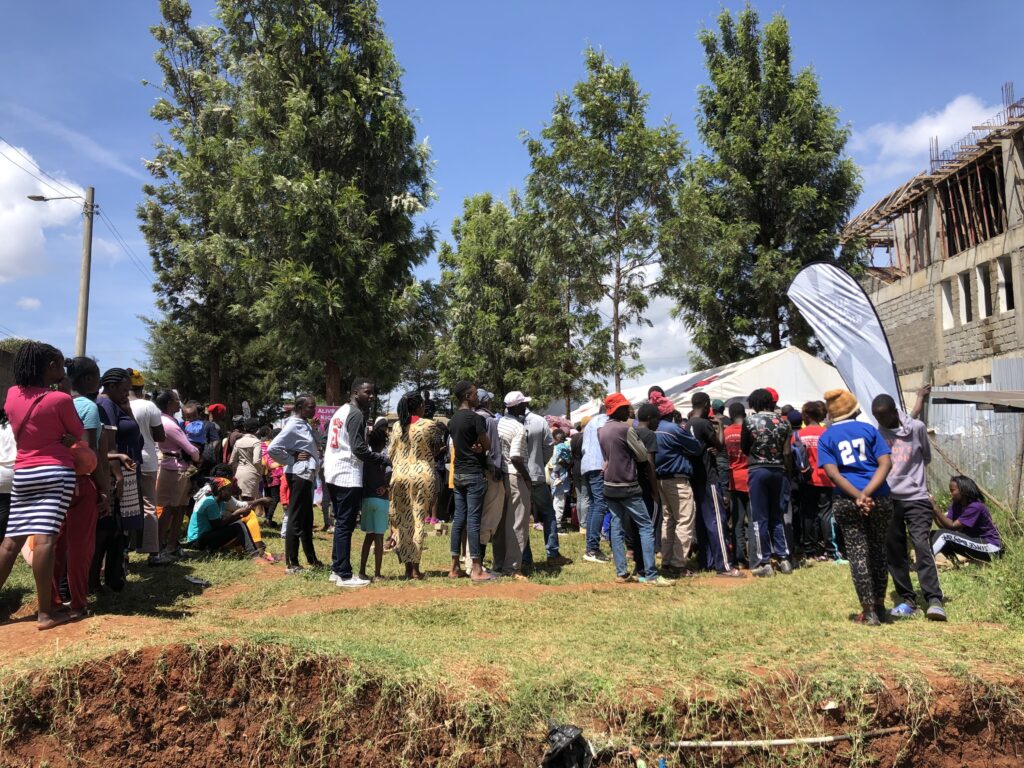
In a situation of such long-standing and scale, no one organisation can “do it all”. Sheba’s attitude to affecting change on the necessary scale and running events like this testing day recognises this. “We [at AK Kenya] are ball makers, we can’t perform medical tests. […] Partnerships allow you to bring in the right expertise and financial assistance to make a program successful and make a bigger impact”, and that’s what we all want. Clearly, she’s right: by working with our test kit donors (My Dawa and Response-Med) and of course Dagoretti Subcounty Hospital Mutuini in Nairobi, the team were able to keep testing for hours after they had intended to close. “We had planned to stop at 3pm but we finally closed at 8pm. Football is so loved by Kenyans and the incentive pulled the crowds in.” Thanks to this love for football and the hard work of not just Sheba but countless others, 781 people were given HIV tests over the day, ultimately running out of time before anything else! And of course, 900 balls made especially for this event were donated, giving hundreds more people access to play and, we hope, to act as a reminder of the importance of staying up-to-date with your status.
“People are still fearful of getting tested even after years of intervention”, Sheba points out – there is no quick fix. All over the world, it will continue to take hard work from medical professionals, governments, charities like Alive and Kicking and tireless individuals like herself to slowly undo decades of deeply entrenched and loaded misinformation surrounding the disease. Our mass testing day is only one step in the marathon to eradicate AIDS, itself only a nudge towards global health justice and education. But if nothing else, to at least 781 people it has already made a potential lifetime of difference.