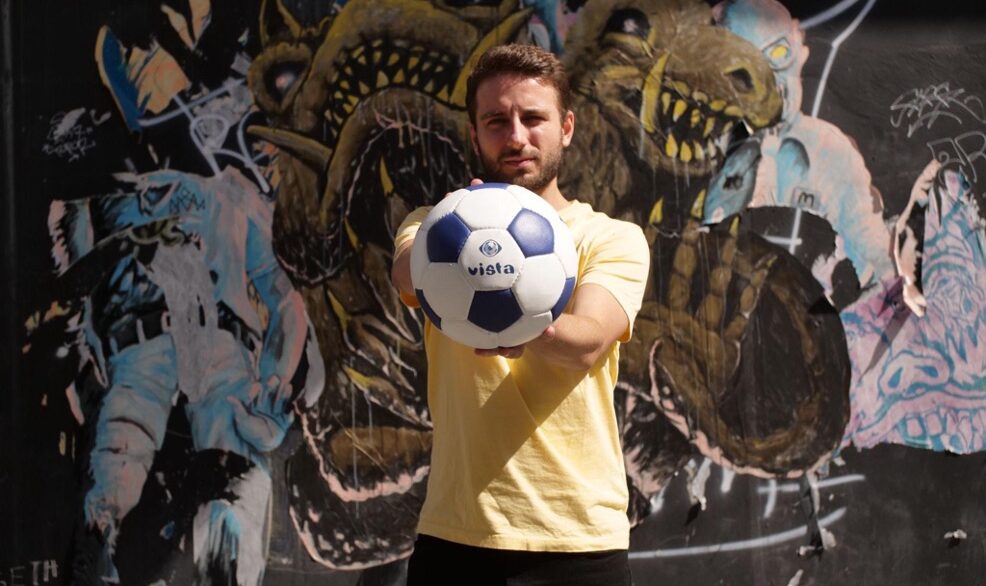
This month we had a chat with Jean-Baptiste de Tourris (not pictured above!), co-founder of Vista and one of Alive and Kicking’s recent collaborators in generating impact throughout the world through football.
So, first things first, what is Vista?
Vista makes footballs in Marseilles, in the south of France. I would say we have an ambition to give back meaning to football, like Alive and Kicking is doing – it’s a great example for us and a great inspiration.
How long has it been going so far?
My wife, Agathe, had the idea two years ago. I wanted to buy a responsible football, but there was nothing like that in France. Then we talked to an engineering school near Lyons about making an ecological football with a social impact. We worked for six months on a research project with 12 final-year students, thinking about what is a football, how we can recycle and ecologically produce one. And then 18 months ago, we met with Ben [CEO of Alive and Kicking].
How did that come about?
So we got the conclusions from the research project… and the conclusion was that it’s not possible to sustainably eco-produce a football in France. Of course I was very unsatisfied so I wrote – in so many languages, thanks to globalisation – and Googled, and YouTubed; I watched videos from Pakistan, and India, and China, and I found a video of Alive and Kicking on YouTube, explaining what they were doing. And I thought wow, this is something very interesting. I looked on LinkedIn and I added Ben, and I emailed him. Two hours later he replied to me – that’s the beginning of the story!
Could you expand a bit on what it is exactly that Alive and Kicking does with Vista?
At the beginning we wanted to do everything in France. After we met with Alive and Kicking we tried to make the panels in France but it’s very hard! [laughs] Then we tried just to stitch them in France. But hand-stitching here ended up costing far too much, so we tried to stitch with a machine, but it’s not the same, it’s not as strong. So in the end, Alive and Kicking is doing the first part of the job – stitching 80-90% of the ball, so the body is open leaving 20cm that we stitch in France [after inserting the bladder]. This takes 45 minutes to do, once an employee has been trained for 3 months.
Of course in terms of efficiency it’s nonsense, we could stitch the entire ball in Kenya and make a higher profit. But we don’t want to do that, we want to work with Alive and Kicking and we want to create jobs in France. So we have this part and we are very proud of it: it helps people here in Marseilles to find a job and reintegrate into work.
There are many factors in measuring environmental impact, but most people think of the carbon footprint. So: a normal football sold in France produces 7kg CO₂. Thanks to the engineering school, we measured this impact for a Vista ball. With full transparency, with the bladder coming from India and body coming from Kenya, and transport to France by plane, we still only have a carbon footprint of 3.2kg CO₂. With higher quantities we will be able to transport by boat, and this will bring the footprint down to 2.3kg, almost a quarter of a classic football.
So was the original idea to make a social impact or to be environmentally friendly?
Agathe and I work with disabled people; having a social impact is very important to us. At the beginning we didn’t have the environmental part of the idea. But we learned so much from this research project.
Maybe because a football is such a common object, as consumers we don’t ask questions: what is a football, where is it made, what becomes of it at the end of its life? We ask questions a lot about food for example, or clothing, so brands have to move. But for footballs we don’t, so brands don’t have the will to change. They have this model, you know, it’s less than 3% for the people working, making the balls, and 30% or more for profit. To my mind, when the customer doesn’t ask for anything, the brands will continue doing what they’re doing.
If you want to have a social impact, and if you want to give jobs to people, you can’t do it by creating more waste, more inequalities, or more bad impact on the environment. And the people working have to be happy and have to be proud to work. If you work for a product where the lifetime is like one week and then it’s waste, it’s in the landfill … people don’t connect.

Who are the people working with Vista?
From the beginning we wanted to work with people currently far from jobs; in France we say “reintegration”, social and work reintegration. We don’t have a lot of funds and we don’t have a big company helping us, so we’ve been working with a group who are authorised by the government under a scheme helping companies to employ people who find it difficult to get work, often due to disabilities. You have two years with these people, part paid by the government, to help them “reintegrate”. After the two years, they will have completed their professional reintegration, and we hope we will be able to give them the option of staying on for a long term job with us.
With this group’s help in January we hired Hourik. He comes from Syria, with his family – he has four kids. He was making shoes in Syria, and was then looking for a job in France. He is highly motivated to work and he loves footballs! With Hourik stitching for us we sold almost 500 footballs in one month. Now we want to prepare for September to December: with the World Cup and Christmas, I hope we will have a lot of orders so at the end of the year there could be five people from this association working for Vista.
Why is football so popular?
I think because it’s easy to play. You need a ball, and that’s it. Even alone, you can play for hours… and if you’re with a friend, it’s so easy. You don’t have to speak the same language, you just have to kick the ball.
It’s funny, I never played football in a club. I play a lot of team sports, I played 15 or 16 years of rugby. But everybody knows what a football is, football makes so much noise in the world. Marseilles is a bit like, maybe Liverpool. Every day it’s filled with shirts of Marseilles, and the city makes so much noise when the team wins a match.
And finally, how can people support Vista?
You can follow me on LinkedIn, I post a lot about Vista. If people in France want to buy a ball, they can do that [website here – note that at time of writing, the footballs are currently sold out!]. If somebody wants to help us organise an event, or help with ideas around environmental impact and the ball itself … any kind of support, financial support or moral support!