Blog

Alive and Kicking x UNHCR impact report: sustainable impact and the refugee crisis

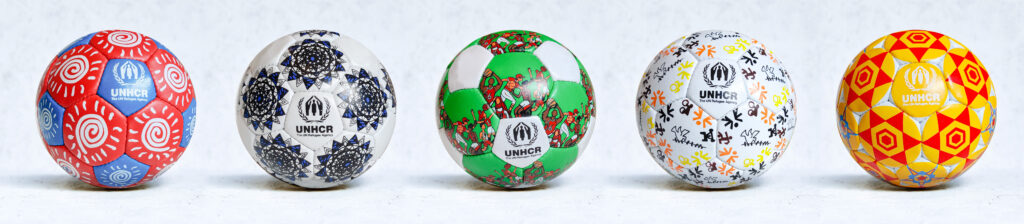
Alive and Kicking x UNHCR impact report: sustainable impact and the refugee crisis Last year we partnered with the UNHCR to bring 5 young people’s football designs to life. The profit made from selling the resulting, limited-edition balls went into supporting refugees around the world, both through the UNHCR and through our own contacts in Kenya, where we will be able to give 8,550 young refugees access to 49,590 hours of play. In a month that has seen more eyes turn to the work being done (by the UNHCR and many others) with Ukrainian refugees, we hope that the data coming in from this collaboration can help us consider how, in a sadly ongoing and global crisis, we can all contribute to positive change in the long run. This month we’re thinking about sustainable impact, individual creativity, and solidarity from local communities extending through to the whole world; and how ‘making an impact’ can mean different things to different people. For Hala, Nadira, Skarly, James, and Gerald, it meant drawing their dream ball. For our team in Kenya – where this partnership helped support 54 full time jobs and, in turn more than 300 individual dependents – it means completing their education, gaining the skills and experience they need with Alive and Kicking to get to where they want to be while building a better life for their families, all of which ripples out into positive social and economic change. For Alive and Kicking and its supporters (that’s you!) it includes backing these employees, who come from vulnerable job groups in the areas we work including adults with disabilities, or with no formal work experience or formal schooling, as well as contributing to their local economy to drive long-term positive change for similarly vulnerable groups in the area. By working with other charitable organisations – from grassroots campaigns in sub-Saharan Africa to global organisations like the UNHCR – we are all able to combine and multiply our impact. That’s why collaborations like this matter.   Looking again at the way people have mobilised around Ukraine’s refugees shows us how collaboration can happen organically on a huge scale: we’ve seen groups and individuals from countries around the region come to help however they are able, with people housing strangers in their own homes, helping with translations and paperwork, even setting up emergency vet stations and pet-food supply stations for those fleeing with their animals. Worldwide, people from Africa and its diaspora have come together to support the large number of African students studying at Ukrainian universities in coming home safely. Protesters have gathered everywhere from Russia to London to the US to express solidarity with those affected. Ukrainians and their neighbours have come together in cities all over the world to make traditional crafts and food for fundraisers. All these examples show the importance of providing concrete aid but also of celebrating humanity (our pets and families, our identities, our cultures) in times of crisis. In the spirit of bell hooks’ “love ethic”, we can see that creativity, generosity, and community especially in the face of hardship are vital to sustainable and regenerative social change. With 4 of the 5 winners of the ‘#dreamball’ competition being refugees themselves, we’re grateful to have had such an opportunity not only to contribute to the struggle against the refugee crisis and to continue supporting our own employees, but also to have been able to showcase the hope and joy of these young people against huge odds. In a flourish perfect for sending off this month and to see all these ideas of creativity, joy, collaboration, and more come together with football, watch how the Japan branch of the UNHCR celebrated Nadira’s ball. : 65

Alive and Kicking x UNHCR impact report: sustainable impact and the refugee crisis Read More »
LGBTQ+ History and “the beautiful game”

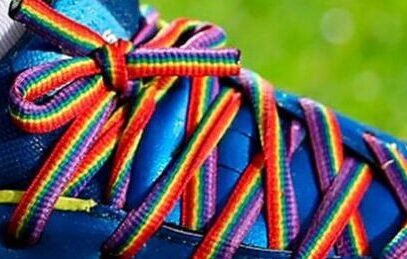
LGBTQ+ History and “the beautiful game” Football and the LGBTQ+ community may seem an awkward pairing: there are zero currently playing ‘out’ Premier League footballers and a long history of normalised homophobia both on and off the pitch despite the FA having banned such behaviour (though often very late, with for instance homophobic chants being banned only in 2007). It is important to acknowledge that this is a problem concentrated in men’s football, with a number of publicly gay and bisexual footballers on professional women’s teams, since the 1920s! It is also important to understand that the homophobia long embedded in professional football was and is often tangled with wider intersectional issues of marginalisation and bigotry. Justin Fashanu for instance – the first professional football player to come out as gay and the first Black British player to be traded for a million pounds, often subject to both homophobic and racial abuse despite his skill and success as a player – was described by Gay Times in 1991 as “as rare in the football world as wasps are in winter”, and the tragedy of his life and death after his coming out is still seen by many as a cautionary tale to closeted male professional footballers. However, football has also historically been a great force for social mobility and the celebration of identities. Increasingly, we are seeing it being actively used as a force for good towards LGBTQ+ rights as well – and this didn’t start on the Premier League or World Cup pitches but in the world of grassroots (including in Africa, with work being done by groups like the Tomorrow Women in Sports Foundation). 10 years after Fashanu’s death the Justin Campaign was set up and formed ‘The Justin Fashanu All-Stars’, a largely symbolic team open to anyone who wanted to play regardless of identity. Today, a search on Pride Sports’ ‘LGBT+ Sports Club finder’ will get you 27 football teams all over England alone, from Brighton to Newcastle, with countless more existing on the more casual word-of-mouth level. In fact, many queer people find huge comfort in their football teams. Little spoken about but important is the sheer joy and ‘body euphoria’ many LGBTQ+ people experience through the sport itself; in more widely homophobic communities teams have rallied to support specific members in the face of wider social bigotry and abuse and can serve as a regular, reliable social refuge. With the UK regressing in its once-high ‘the Rainbow Map’ rankings and the sadly still relatively common estrangement of queer people from their biological families, it’s important to recognise the comfort that such communities can provide. Social transformation often begins at the grassroots level, and we’ve seen how movements in the amateur football community have trickled up into initiatives like FIFA’s Rainbow Laces and Football v Homophobia to encourage acceptance even in people unfamiliar or uncomfortable with queer pride, though there is still a huge way to go. Against expectations, football can be a force for good even in this historically problematic arena, and we look forward to seeing such movements grow both in the grassroots and the mainstream. : 64

LGBTQ+ History and “the beautiful game” Read More »

Mental Health Education in Kenya

Boosting our Mental Wellbeing January is a month when many of us feel stressed, anxious, or low: gloomy weather, a dip in social activity and funds after the festive bustle of late December, and often the added stress of expectations for the New Year, let alone a global pandemic, all add up. Here at Alive and Kicking, however, we’ve just received some good news. Last year we partnered with the Angus Lawson Memorial Trust to empower sports coaches in Kenya to deliver mental health education through football to young people facing disadvantage under their care: the results coming in from this programme are hopeful, and we thought you might like to hear about them too. The programme was set up to further understanding of mental health and reduce stigma, to encourage help-seeking behaviour without burdening an already struggling system, and to provide sports coaches with tools to be able to support their communities. 25 coaches at schools across Nairobi were trained and delivered over 1,300 hours of sessions (despite the impact of COVID) over the year, helping almost 3,000 young people to look after their mental health through difficulties including abuse, loneliness, drug use, parental negligence, and relationship problems. This was done through a two-pronged approach of delivering education through specially designed football drills and equipment (23 of the 25 schools reported that lack of sports equipment would otherwise have been a major barrier to delivery of this programme, and are now also able to use the equipment for other sports sessions for the community) and then empowering young people with the option for access to further support services. 95% of participants said this was the first time that mental health had been addressed in their lives, and rates of improvement in knowledge, attitudes, and behaviour surrounding mental health in themselves and their community were significant. Take-up of support was higher than after previous health programmes, and implementation was easier to incorporate into existing physical education class time and afternoon football sessions, making it a sustainable and organic part of students’ and coaches’ lives. Coaches indicated that they felt many issues couldn’t have been identified without the programme: Irene, a teacher and coach at Langata High School, told us that “students would withdraw, others would get angry, others were not able to speak, others went silent. The programme allows us to identify who needs help and how we help them.” In fact, she felt the programme helped her and the other educators as well as their students, and is planning to study counselling at college to help people further – exactly the kind of long-term impact we hope to make in programmes like this. It seems appropriate to conclude by talking about how we can look after ourselves, and how football can help us do this even without the benefit of coaches like Irene. You might have heard of ‘Blue Monday’ this month – supposedly pinpointed through an algorithm devised by a university psychologist – but the truth is that mental health is a longer-term, more complicated presence in our lives than any one day. Regularly taking part in a team sport, and/or helping coach an amateur or youth team (like Irene), can be a way to make self-care a habit in your life, just as the incorporation of our mental health programme into existing school timetables in Nairobi enabled regular, effective delivery of mental health support. The physical activity, time outside, sense of achievement, and of course community and social aspects all have a hugely beneficial impact on your mental and physical health, regardless of how ‘serious’ your games are. So get out there, join a grassroots team or ask a few friends to the park, and make sure to check in on each other. : 108

Mental Health Education in Kenya Read More »

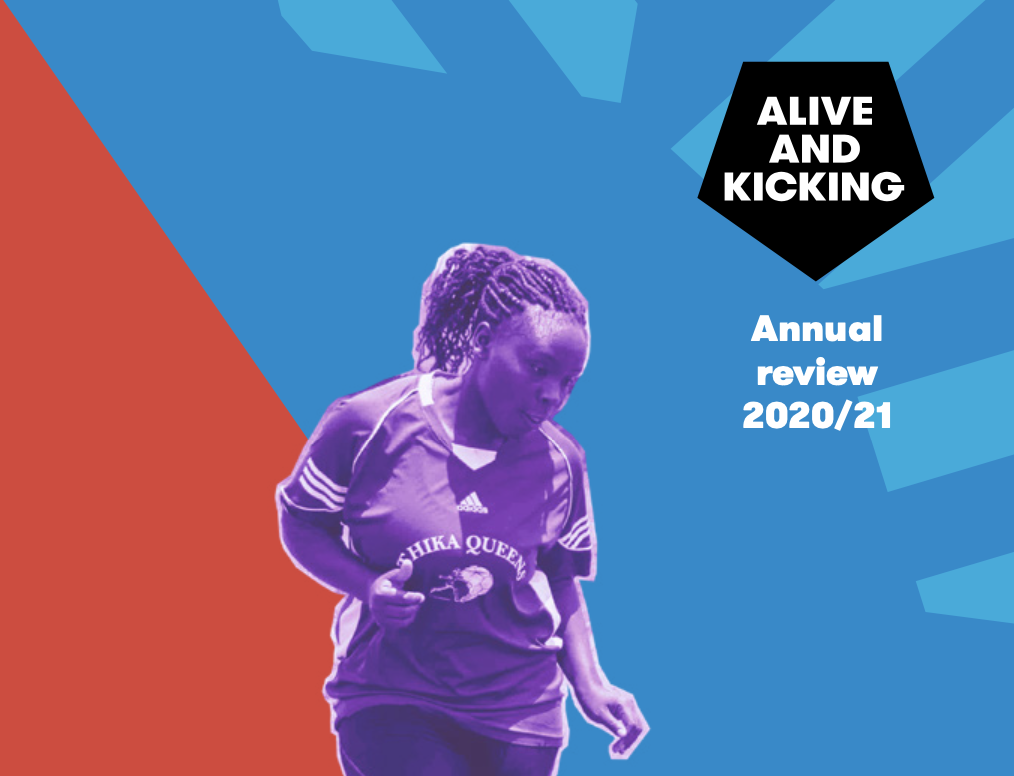
Alive and Kicking Annual Review 2020/21

It gives us great pleasure to share the Alive and Kicking Annual Review of 2020/21, featuring updates on our commitments to the Sustainable Development Goals; the A+K operations in Kenya and Zambia; and a record-breaking fundraising effort.   Thanks to the team at fourfeet for their fantastic design work.   To enlarge the font, please click ‘open’ and then download as a PDF   : 66

Alive and Kicking Annual Review 2020/21 Read More »

AK Fundraising Tournament 2021

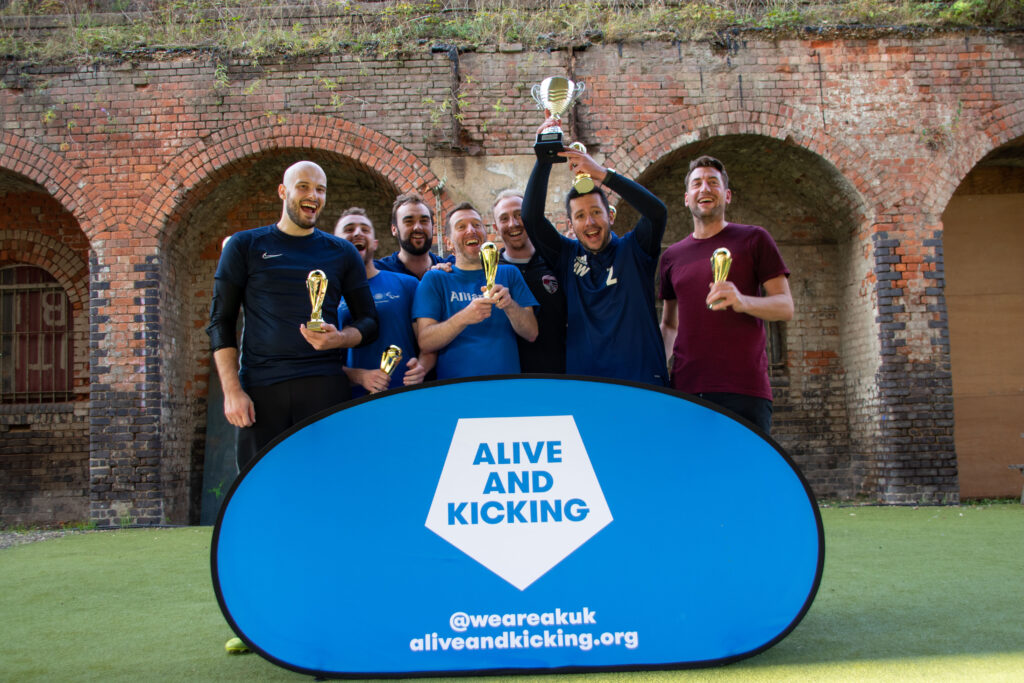
Our annual 5-a-side Fundraising Tournament took place last Friday at Shoreditch Power League, just down the road from our AK UK office. The event was a great success with teams from all over London competing for bragging rights across the city!   The purpose of the tournament was to raise awareness for AK’s work delivering vital health education in communities facing disadvantage, as well as raising vital funds to support the health programmes we deliver. Collectively, just over £6,000 was raised through generous donations from the corporate teams involved. These were: Allianz, Capital Group, Clifford Chance, Clyde & Co, Colossus, Elixirr, Norton Rose Fulbright, Peridot Partners and PJT Partners. A massive thank you to all the competing organisations for their donations. Allianz came out on top as the 2021 Tournament Winners! A big congratulations to them after what was a gruelling afternoon of football in East London. A thank you from everyone at AK to all of the teams involved for their support and efforts. It was a brilliant atmosphere and great to see so many faces in person. Hopefully we will see even more teams there next time too! Click here for a short highlights video from the tournament Click here for a the gallery of team photos : 66

AK Fundraising Tournament 2021 Read More »