
LGBTQ+ History and “the beautiful game”
Football and the LGBTQ+ community may seem an awkward pairing: there are zero currently playing ‘out’ Premier League footballers and a long history of normalised homophobia both on and off the pitch despite the FA having banned such behaviour (though often very late, with for instance homophobic chants being banned only in 2007).
It is important to acknowledge that this is a problem concentrated in men’s football, with a number of publicly gay and bisexual footballers on professional women’s teams, since the 1920s! It is also important to understand that the homophobia long embedded in professional football was and is often tangled with wider intersectional issues of marginalisation and bigotry. Justin Fashanu for instance – the first professional football player to come out as gay and the first Black British player to be traded for a million pounds, often subject to both homophobic and racial abuse despite his skill and success as a player – was described by Gay Times in 1991 as “as rare in the football world as wasps are in winter”, and the tragedy of his life and death after his coming out is still seen by many as a cautionary tale to closeted male professional footballers.
However, football has also historically been a great force for social mobility and the celebration of identities. Increasingly, we are seeing it being actively used as a force for good towards LGBTQ+ rights as well – and this didn’t start on the Premier League or World Cup pitches but in the world of grassroots (including in Africa, with work being done by groups like the Tomorrow Women in Sports Foundation). 10 years after Fashanu’s death the Justin Campaign was set up and formed ‘The Justin Fashanu All-Stars’, a largely symbolic team open to anyone who wanted to play regardless of identity. Today, a search on Pride Sports’ ‘LGBT+ Sports Club finder’ will get you 27 football teams all over England alone, from Brighton to Newcastle, with countless more existing on the more casual word-of-mouth level.
In fact, many queer people find huge comfort in their football teams. Little spoken about but important is the sheer joy and ‘body euphoria’ many LGBTQ+ people experience through the sport itself; in more widely homophobic communities teams have rallied to support specific members in the face of wider social bigotry and abuse and can serve as a regular, reliable social refuge. With the UK regressing in its once-high ‘the Rainbow Map’ rankings and the sadly still relatively common estrangement of queer people from their biological families, it’s important to recognise the comfort that such communities can provide.
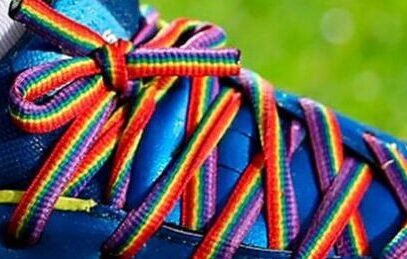
Social transformation often begins at the grassroots level, and we’ve seen how movements in the amateur football community have trickled up into initiatives like FIFA’s Rainbow Laces and Football v Homophobia to encourage acceptance even in people unfamiliar or uncomfortable with queer pride, though there is still a huge way to go. Against expectations, football can be a force for good even in this historically problematic arena, and we look forward to seeing such movements grow both in the grassroots and the mainstream.